Showing posts with label trending. Show all posts
Showing posts with label trending. Show all posts
Sunday, September 20, 2015
By now I'm sure everyone has heard the tale of Ahmed Mohamed, the teenager who was put in handcuffs for bringing his homemade clock to school. This incident is a shameful example of predjudice getting out of hand, but has luckily turned out for the better for Ahmed in all the support he has found following his suspension. Since the story has spread, a lot of questions have been asked over the scenario. Did President Obama really need to get involved? Does the clock work? Does Sarah Palin really still believe that it's "more than a clock?" However, the one that I've read above any other is:
"Whould this have happebed if he was white?"
I read a pretty interesting article concerning this on The New York Post.
While I don't agree with the claim of this whole story being a "False, convient tale of racism" I do think the author's questions pose for a compelling conversation. Is the issue bias? Or is it something else?
In my opinion, it is difficult to deny that Islamophobia had a minor (if not major) role in Amed's arrest and suspension. However, I have to admit, when I first heard the story, my mind immediately went to an event that happened in my own community this past Wednesday, when a portion of the freeway was shutdown for an hour because of a cooler on the side of the road.
The New York Post article also rattles off some examples of overeactions to certain, unthreatening behavors in schools. Some students mentioned are white, some are not.
We can all agree that the reactions are extreme, we can all agree that the way they were handeled completely wrong, but what about the source of the behavior? From what illness is this a sympotom of?
When I play this out as happening at my old high school, which was predominantly white, I can very easily see a student proudly showing off his clock, and security thinking nothing of it, but at the same time, I can't rule out the possibility of the situation getting out of hand in the same way as it did for Ahmed, because I know it happenes all the time.
So, would this have happened to one of Ahmed's white classmates had they brought in a clock?
It's hard to say, but I think the greatest issue that's floated to the top of this entire ordeal is society's knee-jerk reaction to look for something to roll our eyes at, rather than allowing it to motivate us to try for something better. It always has to be dilluded by some debate. What were the administrators who called the police thinking? What was the racist-to-non-racist ratio? Who knows? Who cares?
It was another line added to the sad song of discrimination that too many minorities hear thanks to society's branding of all non-whites as violent and that's should matter.
It should have stopped before Treyvon.
It should have stopped before Tamir.
It should stopped before Ahmed.
How many more children need to fall victim before we admit that yes, racism is a problem, racism is the problem? I fear for a country that keeps asking why white kids aren't getting free white house tours instead of why black kids are getting shot.
But that's just me. Like I said before, I think this topic provides for some really, really compelling discussion, so for anybody reading this, I am personally challanging you to get out of your comfort zone and to share your opinion. What was your reaction to the story when you first heard it? What connections did you make? What do you think is the greater issue? Please, contribute below!
"Whould this have happebed if he was white?"
I read a pretty interesting article concerning this on The New York Post.
While I don't agree with the claim of this whole story being a "False, convient tale of racism" I do think the author's questions pose for a compelling conversation. Is the issue bias? Or is it something else?
In my opinion, it is difficult to deny that Islamophobia had a minor (if not major) role in Amed's arrest and suspension. However, I have to admit, when I first heard the story, my mind immediately went to an event that happened in my own community this past Wednesday, when a portion of the freeway was shutdown for an hour because of a cooler on the side of the road.
The New York Post article also rattles off some examples of overeactions to certain, unthreatening behavors in schools. Some students mentioned are white, some are not.
We can all agree that the reactions are extreme, we can all agree that the way they were handeled completely wrong, but what about the source of the behavior? From what illness is this a sympotom of?
When I play this out as happening at my old high school, which was predominantly white, I can very easily see a student proudly showing off his clock, and security thinking nothing of it, but at the same time, I can't rule out the possibility of the situation getting out of hand in the same way as it did for Ahmed, because I know it happenes all the time.
So, would this have happened to one of Ahmed's white classmates had they brought in a clock?
It's hard to say, but I think the greatest issue that's floated to the top of this entire ordeal is society's knee-jerk reaction to look for something to roll our eyes at, rather than allowing it to motivate us to try for something better. It always has to be dilluded by some debate. What were the administrators who called the police thinking? What was the racist-to-non-racist ratio? Who knows? Who cares?
It was another line added to the sad song of discrimination that too many minorities hear thanks to society's branding of all non-whites as violent and that's should matter.
It should have stopped before Treyvon.
It should have stopped before Tamir.
It should stopped before Ahmed.
How many more children need to fall victim before we admit that yes, racism is a problem, racism is the problem? I fear for a country that keeps asking why white kids aren't getting free white house tours instead of why black kids are getting shot.
But that's just me. Like I said before, I think this topic provides for some really, really compelling discussion, so for anybody reading this, I am personally challanging you to get out of your comfort zone and to share your opinion. What was your reaction to the story when you first heard it? What connections did you make? What do you think is the greater issue? Please, contribute below!
Sunday, August 30, 2015
And the Moonman for Best Hip Hop video goes to.. #VMAs http://t.co/SWRN5MPOOT
— MTV (@MTV) August 31, 2015
Nicki
Manaj's acceptance video has been a buzz all throughout social media
for the past few days. Her firm, assertive stance on white
artists winning awards by appropriating black artists' styles has
earned her a title as a revered voice of reason in the music
industry: a beacon of light. Manaj further inspired fans on stage at
the VMA's, where she called host Miley Cyrus out for her
tone-policing comments in a recent Time interview where
she claimed that Manaj was hurting her cause by not being
"polite."
As
awesome as it was, the speech was the end all to a greater issue. Not
to cultural appropriation, and especially not to tone-policing: an
issue that remains a huge threat to oppressed peoples outside of the
pop culture scope. However, as Maisha
Z. Johnson points out in a recent Everyday
Feminism article,
the whole ordeal does provide an important lesson to be learned, and
creates an ample opportunity to those blinded by their
bias to step forward and educate themselves.
Check out the article here.
Post
your thoughts in the comments below.
Tuesday, June 9, 2015
Christian privilege is being able to practice your religion without any interference from society. This has been a long running issue for the Muslim community, however, it seems that one very small success has been made this past weekend. According to The Guardian the supreme court has overseen the case concerning Abercrombie and Fitch's firing of Muslim workers for wearing hijabs on the grounds of "breaking the dress code." The courts have ruled against Abercrombie in an 8-1 decision, under their the provision that her employer openly stated that she was not hired because of the religious accommodations the company would have to make for her, which is a direct violation of Title VII of the Civil Rights Act.
This is a victory not just for the Muslim community, but for our country as a whole. In an era of rampant Islamophobia in the United States, we need as many Muslim victories as we can possibly get. This supreme court case assures a single extra degree of equality for women in the workplace, and as small of a victory it is, I still feel that it is one to celebrate nonetheless.
See more information about the court case: here.
See more information about the court case: here.
Tuesday, June 2, 2015
A couple of weeks ago, I mused on the implications of Caitlyn Jenner's coming out as transgendered. At this point, it seems silly to not to do the same for her debut as a woman on Vanity Fair. Aside from a couple of ignorant tweets, Caitlyn's reception has overall been very supportive. Many are calling this transition a turning point for trans acceptance in society, however, that isn't entirely true.
The media coverage of Jenner's journey definitely has given the trans community its biggest spotlight in history, but "visibility is a double edged sword," says Kel Kray, Everyday Feminism contributor. In a society where "fitting in" is synonymous with "assimilation," it's important to watch bouts of awareness such as these with a weary eye, and to make use of them by clearing up some misconceptions while the iron is still hot. Kray's article "10 Things Trans Activists and Allies Need to Remember That Have Nothing to Do With Caitlyn Jenner" attempts to do exactly this.
Definitely worth a read. Check it out here.
Sunday, May 24, 2015

It's often argued that success isn't about who you are, but how hard you work. While those coming from financially sound families do have an upper-leg, the less fortunate ones have the opportunity to reach this same level through hard work and a good education. After all, we aren't solely defined by our home life, and the differences it allows to our character is relatively small. The problem is, as this comic argues, "...over the years all these little differences, they start to add up, to build into something bigger."
"On a Plate" accurately and profoundly expresses the implications of privilege. Closing these disparities isn't a matter of socialism, it's a matter of rectifying the fact that "equal opportunity" doesn't exist in this society.
Check out the whole comic here.
Sunday, April 5, 2015

This weekend everyone on my Facebook feed seemed to be up in arms over Jaden Smith wearing a dress to coachella. I don't really understand the cause of the hype. First of all, it looks more like an over sized T-shirt than a dress, and second, even if it was a dress, who cares?
Men always seem to be dressed in women's clothing under an absurdest context, but does it always have to be absurd? After all, society allows women to cross-dress with no problem. In the words of Mark Blechner, Author of Sex Changes: Transformations in Society and Psychoanalysis " Marlene Dietrich in a tuxedo was considered very erotic; Jack Lemmon in a dress was considered ridiculous." Similar reactions to cross dressing celebrities have been gauged throughout the years, but why? Why is there such backlash? Why do we have a reaction to it all?
NYU released an analysis of this issue in 2009, suggesting that it's all a symptom of a cultural stronghold of heteronormativity.
Heteronormativity is defined as the social norm that suggests that people fall into distinct, complimentary genders. However, when people challenge the behaviors assigned to their sex, their gender roles, this in turn challenges a prevailing societal norm. When a celebrity breaks social norms there is often a widespread, out of proportion response. That's why the internet practically blew up when Jennifer Lawrence cut her hair or Jaden Smith is seen in a not-so-masculine outfit. Our society conditions us to care more about it than it really matters.
But the reality is, people aren't solid blocks of gender. Females have masculine qualities, and males have feminine qualities. People cross the (imaginary) line of boy-girl rules on a day to day basis, and nothing bad has happened as a result of it. The negative repercussions start when the judgement comes in. It starts when hate is used to emphasize little differences in each other.
The concept of violating gender roles is the same as violating racial roles, or class roles. These designations do not exist, and we should not allow others to think so by consonantly reacting to the things that do not adhere to our norms.
Sunday, March 29, 2015
Last week I came across an article arguing that the word "thug" is the new "n----r."

Could this be true?
This Friday I also had the privilege of sitting in on a high school presentation of Dr. Neal Lester's "Straight Talk about the N-Word." During which, he talked about the connotations of the N-word throughout history, and why it is considered to be so offensive.
I learned that not only was it a word to express hate, but it was often just a commonplace word to describe African Americans. In early 20th Century pop culture, the n-word was usually paired with derogatory statements, pictures, or lyrics. The n-word wasn't just something people randomly yelled when they wanted to hurt African Americans (although it was frequently used for that purpose as well). It was a word used to demean and categorize a whole subgroup of people on a day-to-day basis.
I had already read the article before I went to this presentation, and as I listened, I thought of the similarities between "thug" today and "n-----" in the past.
"Thug" is a word used far too often to describe African Americans. Every time we see a black victim of violence, the media is always trying to justify their attacks by trying to prove they are "thugs." And what exactly is a "thug?" What does one have to do to be considered a "thug?" The answer depends on who you ask, but to get a basic idea, I looked it up on Google images. Here's what came up:
Notice anything they all have in common?
These are the over exaggerated images that come to mind when somebody tries to imagine a thug. Like the n-word, "thug" is a word encompassing a negative connotation, perpetuating the mistreatment of African Americans that is used in a commonplace context. Because of this, I am entirely behind the idea that "thug" shares nearly identical implications with the n-word.
Is "thug" the new "n-----r?" It could be, it's used just as commonly to say something very similar, but that's just my opinion. What are your thoughts?
Sunday, March 22, 2015
I am cisgendered. Which means that I can never fully understand what it feels like to misgendered, or how detrimental this can be to somebody's self esteem, but I do know that being recognized as the correct gender is a huge issue within the transgender community. This is why it is so important to be diligent in recognizing and supporting those who are transgendered or transitioning, and the very best way to do that is with our words. Specifically gender pronouns.
As Everyday Feminism argues, using the correct gender pronouns is essential to becoming an effective ally for the LGBTQ community. People want to be called the right pronouns. It sounds like an easy concept to grasp, after all no "sir" wants to be called "ma'am" and the same applies in vic versa. But misgendering means a whole lot more to those who are transgendered. Like I said, I personally believe that this is a feeling no cisgendered person can come close to fully understanding, however, this is an article that really put things into perspective for me. It's called "What You Are Actually Saying When You Ignore Somebody's Gender Pronouns" Check it out!
As Everyday Feminism argues, using the correct gender pronouns is essential to becoming an effective ally for the LGBTQ community. People want to be called the right pronouns. It sounds like an easy concept to grasp, after all no "sir" wants to be called "ma'am" and the same applies in vic versa. But misgendering means a whole lot more to those who are transgendered. Like I said, I personally believe that this is a feeling no cisgendered person can come close to fully understanding, however, this is an article that really put things into perspective for me. It's called "What You Are Actually Saying When You Ignore Somebody's Gender Pronouns" Check it out!
Sunday, March 15, 2015
As one who grew up in a Hispanic family, operating among a multi-language environment was never anything strange to me. I have members of my family who are fluent in both English and Spanish, and others who can only speak one or the other. For most of my life, I operated under the belief that the language somebody spoke just was. I never really focused on the fact that I could understand my mother when she was talking to my aunts, but I couldn't understand my grandmother when she was talking to my great aunts. To me, all these verbal barriers weren't a matter of inferiority vs. superiority, it just meant that I couldn't understand certain people's gossip. However, it has recently come to my attention that as a society, we do value those who speak the same language as us a little more than we should.
The multi-language warning label on your hair dryer may lead you to think different, but America mostly operates as a single-language country. For those who don't speak English, it is difficult to do day-to-day tasks that require communication, an uphill battle to get an education, and nearly impossible to get a well-paying job. On top of this, many who face this language barrier in America are personally attacked for failing to learn our "mother tongue." This is a form of discrimination called linguiscism. We've all heard somebody at one time or another say that only "true Americans" speak English. While many of us don't have such extreme tendencies of liguicism, we all have some kind of unconscious bias when we encounter people who don't speak the same language as us, or who have accents that make them difficult to understand.
Whether its a completely different language, or some different dialect of American English, a lack of fluency in our own language often goes hand-in-hand with being labeled incompetent or uneducated.
I met my turning point in linguistic perception when I was seventeen years old. I asked my mother why none of her siblings were fluent in Spanish, and she said the reason why was because they were banned to speak Spanish in their house. My grandfather, the grandson of Mexican immigrants, was often bullied for his lack of fluency. To him, banning Spanish was not only a form of protecting his children, but a way of guaranteeing their success. Since then, I have been told by many of my Hispanic peers that the same thing has happened in their household.
It is shameful to see just how far we let lingucisim get by. In privilege talks, linguiscism is mostly scanned over, but it is one of the most prevalent forms of discrimination in our country.
Linguiscism is a difficult concept to combat, because many feel that the only way to counter it would be to learn as many langauges as possible so that we can all understand each other. While that would be great, that is not a realistic expectation for most people. Honestly, just like any form of discrimination, the very best first step one can take is to practice empathy and to watch for the unconscious bias within oneself. Tolerance isn't a quality exclusive to multi-langauged individuals, and this extension of empathy can mean far more than any words ever could. When we allow these actions speak louder than words, the dialect we're using hardly even matters.
The multi-language warning label on your hair dryer may lead you to think different, but America mostly operates as a single-language country. For those who don't speak English, it is difficult to do day-to-day tasks that require communication, an uphill battle to get an education, and nearly impossible to get a well-paying job. On top of this, many who face this language barrier in America are personally attacked for failing to learn our "mother tongue." This is a form of discrimination called linguiscism. We've all heard somebody at one time or another say that only "true Americans" speak English. While many of us don't have such extreme tendencies of liguicism, we all have some kind of unconscious bias when we encounter people who don't speak the same language as us, or who have accents that make them difficult to understand.
Whether its a completely different language, or some different dialect of American English, a lack of fluency in our own language often goes hand-in-hand with being labeled incompetent or uneducated.
I met my turning point in linguistic perception when I was seventeen years old. I asked my mother why none of her siblings were fluent in Spanish, and she said the reason why was because they were banned to speak Spanish in their house. My grandfather, the grandson of Mexican immigrants, was often bullied for his lack of fluency. To him, banning Spanish was not only a form of protecting his children, but a way of guaranteeing their success. Since then, I have been told by many of my Hispanic peers that the same thing has happened in their household.
It is shameful to see just how far we let lingucisim get by. In privilege talks, linguiscism is mostly scanned over, but it is one of the most prevalent forms of discrimination in our country.
Linguiscism is a difficult concept to combat, because many feel that the only way to counter it would be to learn as many langauges as possible so that we can all understand each other. While that would be great, that is not a realistic expectation for most people. Honestly, just like any form of discrimination, the very best first step one can take is to practice empathy and to watch for the unconscious bias within oneself. Tolerance isn't a quality exclusive to multi-langauged individuals, and this extension of empathy can mean far more than any words ever could. When we allow these actions speak louder than words, the dialect we're using hardly even matters.
Sunday, March 8, 2015
This Buzzfeed article has been trending for a while, and I've felt the need to share it since the first time I came across it. José's story is as shocking as it is tragic. Most importantly, it is representative of the unconscious bias that many of us have.
It is unlikely that each one of the hundreds of employers José contacted consciously decided not to hire him because he had a Hispanic name. Scenarios like this happen all the time due to an unconscious bias perpetuated by the stereotypes associated with members of each race. John, Joe, or George are perceived as more professional than Juan, José, or Jorge because employers often associate ethnic names with the stigma of an ethnicity. In José's case, he was assumed to be a migrant worker, and immediately dismissed. Bias, whether conscious or unconscious, hurts people all the same. It's important to be aware of the different kinds of bias so that we can try to identify them in ourselves and others, and then fix the problem from there.
Sunday, March 1, 2015
In the past couple of months, we have gone over a number of forms of privilege (white, thin, able-bodied, class, ect.) and the actions and fallacies that cause major disparities in our society. While examples of these actions and fallacies mostly include racism, discrimination and hate crimes, there are more out there. That's why, today, I want to dive into the power of words.
We all know that the old "sticks and stones" rhyme we used to hear in elementary school is about as accurate as claiming that the sky is magenta. Words can cause some serious damage. Currently, our culture is littered with damaging words that are not only offensive, but active in the perpetuation of the inequality overwhelms this country. One specific sub-group which faces the brunt of this epidemic is the disabled community.
When it comes to words of offense, there are some that are not up for debate. For example, "faggot" or the n word. Words like these have been known to be spoken out of hate, and, generally speaking, we've come to the consensus that we're not supposed to say them. However, there are still many harmful words that have slipped under the radar of offense simply because they don't offend us. For example, "crazy," "retard," "cripple," "bipolar," and "spaz." Many of us hear, or even say, at least one of these words on a day to day basis. As ordinary as they may seem, however, they still have a derogatory effect. This is called ableist language.
Imagine if somebody used "crazy" to describe their mother who had Alzheimer's, or if somebody called a veteran missing one of his legs a "cripple." That would be extremely offensive! Why is then, that these words are acceptable to use in other contexts? The answer is that they really aren't, it is just assumed that they are because there are so few activists against ableist language. Ableism really is something that we should work towards avoiding. There specific terms that cut into specific groups more than others. Just as we abstain from saying racial slurs, or homophobic phrases, we should extend the same act of diligence to the disabled community by choosing alternatives to ableist language.
For some examples of non-ableist alternative, check out the chart from Upworthy!
We all know that the old "sticks and stones" rhyme we used to hear in elementary school is about as accurate as claiming that the sky is magenta. Words can cause some serious damage. Currently, our culture is littered with damaging words that are not only offensive, but active in the perpetuation of the inequality overwhelms this country. One specific sub-group which faces the brunt of this epidemic is the disabled community.
When it comes to words of offense, there are some that are not up for debate. For example, "faggot" or the n word. Words like these have been known to be spoken out of hate, and, generally speaking, we've come to the consensus that we're not supposed to say them. However, there are still many harmful words that have slipped under the radar of offense simply because they don't offend us. For example, "crazy," "retard," "cripple," "bipolar," and "spaz." Many of us hear, or even say, at least one of these words on a day to day basis. As ordinary as they may seem, however, they still have a derogatory effect. This is called ableist language.
Imagine if somebody used "crazy" to describe their mother who had Alzheimer's, or if somebody called a veteran missing one of his legs a "cripple." That would be extremely offensive! Why is then, that these words are acceptable to use in other contexts? The answer is that they really aren't, it is just assumed that they are because there are so few activists against ableist language. Ableism really is something that we should work towards avoiding. There specific terms that cut into specific groups more than others. Just as we abstain from saying racial slurs, or homophobic phrases, we should extend the same act of diligence to the disabled community by choosing alternatives to ableist language.
For some examples of non-ableist alternative, check out the chart from Upworthy!
Sunday, February 8, 2015
So the Super Bowl was exactly one week ago, which means I may be late to the party, but I still felt like Alway's "Run Like a Girl" ad was worth mentioning. Growing up, "Like a girl" was always something I heard with a negative connotation, but it never really put me down, I just accepted it. I was a girl and therefore I ran slower, I couldn't throw, I wasn't as smart. Looking back, I know that it isn't the phrase that is harmful, but the perpetuated stereotypes that I was fed growing up. A couple of my friends and I were going over this topic last week and many recalled vivid memories of their parents putting an overbearing emphasis on being feminine when they were younger.
What makes this ad so important isn't just the empowering message it gives to young girls. As the advertisement already shows, the girls featured in this video are virtually unaware of the gender bias ringing in the statement "like a girl." The key to this video's success is it's true audience: adults, current or future parents and members of society who actively reinforce these stereotypes. Sure, it's inspiring to girls, but it also challenges members of society to re-think the phrase "like a girl" and to rethink these stereotypes in general. If it's simple for a group of kids, then it should be simple for us too, right?
Kudos to the #LikeAGirl campaign that is moving in so many ways!
Sunday, February 1, 2015
Earlier this week Disney released its design for their first Latina princess ever. Corks were blown off of campaign bottles, parades filled the streets, and the media celebrated this leap in pop culture diversity. All for basically no reason at all. The initial problem here is that we are waaay past due for a Hispanic princess; however, there are enough flaws with Elena of Avalor that Disney should consider going back to the drawing board with this one.

The special irony here is that just like Latinos in the real world, Elena too is being marginalized in her land far far away. Unlike the first Arabic princess, the first African American princess, or the abundance of white princesses Disney has released, Elena's debut will not be on the silver screen, but on the children's show Sophia the First. Sadly, Elena is nothing more than a supporting role in a show where her appearance is likely going to be swept under the rug and forgotten.
Also, in a statement made by a senior vice president of Disney Junior, Nancy Kanter, it was revealed that "All [Sophia] characters come from fantasy lands that may reflect elements of various cultures and ethnicities but none are meant to specifically represent those real world cultures." Meaning, the actual culture of Latin Americans will not be represented along with Elena, which is arguably what gives the introduction of the character purpose. It isn't about the quotas or the skin color, but the accurate representation of individuals who are being underrepresented in society. When it comes to this standard, Disney is completely missing the mark.
There has been talk about Elena getting her own spinoff series in 2016, there is still room to be pessimistic. After all, it is very likely that creation was not a part of the original Sophia blueprints, but to rectify a PR mishap when Disney Junior originally announced Sophia the First and producers labeled the series's obviously Caucasian main character, Sophia as Latina. Whatever the case is, the introduction of Elena is far from the break through that it is being presented as. Yes, it is great that Hispanic children will be presented with a character that they can finally relate to at 9:30 am/8:30c, but will Elena dolls get a spot on Disney Store shelves? Will there be Princess Elena Halloween costumes, lunch boxes, or backpacks? Will there be a Princess Elena at Disneyland? The answer to all of these questions, more than likely, will be no. So why should we be celebrating this as a victory?The bigger question is, what does this have to do with privilege?

As one of my girls began to show off the princess sticker book she got for Christmas, she made a remark that there were no big stickers of Princess Tiana and seemed deeply disappointed by this. Children can sense these disparities early on. According to an "animation census" released by Buzzfeed 71.% of Disney Princesses are Caucasian.
White children are given a mass of princesses they can look to based on the loose argument that most fairy tales are based off of European characters. Meanwhile, children of color continue to wait....and wait....and wait.
Disney needs to be more diverse. There's no doubt about that, but garlanding a minor character in a minor series is not going to cut it. I say go big or go home. Anything that falls short of "big" this late in the game in unacceptable. Here's to hoping Disney, along with other animation studios, start to become more brave with their character designs and more accurate with the society they represent. None-white people are not make-believe, so we should really stop acting like it.
Sunday, January 4, 2015
The New Year's resolution has always been one of my least favorite holiday traditions. The first of January is just an ordinary day, there's nothing that's specially ordained it to be a day where change is any more possible or will power is any stronger, yet many still like to follow the "New Year new me" trend. What I find to be the most regrettable part of it all is the fact that the number one New Year's resolution made is to lose weight. It's unfortunate that so many people are so displeased with their bodies that to many the biggest accomplishment for their year will be couple of shed pounds. I think that one of the biggest factors of this mentality is demonstrated through the media this holiday season. The fact that weight loss is a widely accepted New Year's resolution is no secret. That's why, early this January,one can expect to see morning TV shows, magazines and advertisements bloom with headlines selling all kinds of tricks, miracle diets and super foods to make the pounds melt away in no time. The new year is the high tide of society's obsession with dieting and it needs to stop.
It isn't just because dieting has been argued to be counterproductive and even unhealthy among doctors. It's offensive. Not everyone wants to be thin, not everybody can be thin. Perpetuating the idea that this is the New Year is when people are supposed to make the decision to dramatically change their bodies is dangerous. It tells people that the only way to finish the year successfully is to become thin, but noticeable results take a while, and a 365 expiration date can make people impaitent. When counting calories, becoming vegetarian, or the detox tea doesn't work, people start taking more extreme measures.
I saw the consequence of the calander-based weight loss first hand with my twin sister who, at 240 lbs; wanted to lose 80 pounds by the beginning of her next school year. She cut off junk food, ate nothing but fruits and vegetables, then stopped eating altogether. By Junior year, my sister was praised for losing 30 pounds, but she had also developed an eating disorder nobody knew about until the following Novermber. When I came to visit over the holidays it seemed as if she had picked up healthier eating habits, but constantly asked if it looked like she had gained weight since the last time I saw her. Reflecting on my sister's experiences, I can't help but blame America's anti-curve culture for the way she sees herself. Our plus sized population being so under represented is one issue, but demeaning this community by promoting weight loss as much we do at the beginning of the year contributes to the problem just as much.
The concept of New Year's resolutions aren't entirely evil, I think the biggest issue lies in society's definition of what a "better self" is. For many this comes from the inside. Take Demi Lavoto for example, who list weight but decided to show off some gained confidence instead by posting a picture of her at the beginning and end of the year side by side on instagram and captioning it, "I was beautiful then and I'm beautiful now." This is how weight loss resolutions should be approached if approached at all. Losing weight doesn't mean that the heavier version of somebody was any less than the thinner. This kind of milestone should be presented and celebrated as an increase in not beauty or self worth, but, "health, balance, endurance and consistancy" as Demi continues in her post.
Inspiring words aside, if there's anything that we should strive to have more healthy, more balanced and more consistent by the end of the year, it should be our outlook on body image and the way we present it to others. Maybe we won't shed all the insensitivy away by 2016, but I think it's a pretty good goal to keep in mind.
Sunday, December 7, 2014
Confession: I am a huge nerd. So, of course, when I heard there was going to be a new Star Wars movie, I just about ripped my hair out in excitement.Last week, the first trailer for Star Wars: The Force Awakens was released and with it came an explosion of questions, comments and concerns from the Star Wars fan base. Everything seemed to be going great and then...the bigots joined the party.Within minutes of the trailer's release outraged tweets from fans began to surface. Their biggest complaint : the casting of John Boyega, who is shown as a stormtrooper in the first 3 seconds of the clip. What was wrong with him? Well, he was black. Here are some quotes from a couple of gems I'd found:
" The new Star Wars trailer... I'm calm... "There has been an awakening, have you felt it..?" IT'S A BLACK GUY STORMTROOPER, OMFG Whaaaaaat?! "
"A black stormtrooper? THANKS, OBAMA"
AND
"How about the stormtrooper who just realized he became the third black guy in the galaxy?"
Most people were upset by the concept of a black stormtrooper because, in their opinion, it interferes with the accuracy of the new movie. In the original trilogy, it has been stated that all stormtroopers are clones of Jango Fett, bounty hunter and father of Boba Fett. If that's the case, all the stormtroopers should be white, right?
Well, no. Clone troopers were what made the original stormtrooper corps, By the time of the Second Imperial Civil War, well over a century since the fall of the original Empire, the vast majority of stormtroopers were composed primarily of enlisted soldiers. This opens the possibility of all kinds of diversity within the corps, not only in race, but species.
Secondly, the guy who plays Jango Fett, Temuera Morrison, isn't even white. As a recent article in The Atlantic points out, "he's a New Zealand born person of brown skin an Maori descent."
So, the argument that John Boyega doesn't belong on the cast of The Force Awakens is supported by no concrete evidence whatsoever.
It's just racist.
I feel that the Boyega controversy holds a couple of profound implications about society.
For example one of the main issues people said they had with the controversy was the media's reactions to the reactions of the star wars fan base. Many claimed that this scenario was just another example how people tend to jump the gun on calling things "racist." I have heard more conservative friends of mine make similar comments after similar stories hit the national radar. It's like we're searching for a problem, they say.
First of all, complaining about a cast member solely on the basis of their race is, by definition, racist. Nobody complained about the stormtrooper not looking like Jengo Fett, which just may have been a more reasonable complaint, they asked why he was black if the original face for the stormtroopers was white. Some even lamented that Boyega's casting was just another example of how Hollywood's newfound love for political correctness is ruining movies. This is not only incorrect (Hollywood is still extraordinarily white washed) but once again, racist. And yet, one week later, as I go through the comments on articles about the Boyega controversy, I see people defending these comments as innocent concerns from a passionate fanbase. I see accusations of people failing to see the "bigger picture." Well, there definitely is a bigger picture to be seen here, but anybody who is making excuses for these comments is holding the picture upside down.
We like to say that by 2014 racism cannot possibly exist and therefore anybody accusing anybody of racist remarks is over-sensitive, too liberal or obsessed with political correctness. If the events and protests within the last couple of weeks have spelled anything out, it is that this is simply not true. When the public cries out over this breed of uproar, be it as shocking as Ferguson or a simple as a bigoted response to a movie trailer, and we as a society respond by saying that it's all just a big soap box over nothing we are sweeping the bigger issue under the rug.
This nonchalant response not only causes people to ignore these bigger issues, it causes them to normalize the behavior that goes hand and hand with it. "Yes, some police officers are guilty of racial profiling. That doesn't mean we need to reform the system." "Yes, there are some racists online, but if we ignore them, their voice doesn't really matter." Simple statements like these may seem harmless, but in reality, they enable a kind of mentality that is toxic to our social ecosystem. Normalizing or dismissing bias allows for it to be embedded in our culture.
Since the trailer's release, John Boyega released a statement to the critics of his casting by telling them to "get used to it." A simple but powerful response; however, when it comes to racism in our own community we should defiantly not get used to it. We should speak out and make it clear that this kind of behavior is nowhere near acceptable.Awareness may not solve racism entirely, but it will prevent ourselves from making the problem any worse than it already is.
And really, that is the very least we can do.
Sunday, November 23, 2014
This morning, Michael Eric Dyson, a professor of sociology at Georgetown University and former mayor of New York City, Rudy Giuliani got into an argument that was so heated I probably could have fried an egg on the laptop I was watching it from. Tonight's post was supposed to be on the disproportion of global access to a quality education; however, when I came across this video it felt like I was struck by lightening. I had to write my comment down: Rudy Giuliani's assertion that law enforcement needs to crack down on black offenders more than racial discrimination is not only ridiculous but down right offensive. I was disgusted by the ignorance of his comment.
The video was short, but the few words that were exchanged between the two men seemed to be enough to completely mirror a conflict in our communities' streets right before my very eyes. If the events of past two years have taught us anything it's that racial discrimination is a societal plague that has yet to be cured and that has proven to be fatal. We'd like to believe that by 2014, bigotry like this has been eradicated, and that's why we like to make excuses as Mr. Giuliani did when he said that the real problem lies within the races themselves. Unfortunately, this kind of mentality only furthers society away from progress. Pointing fingers in the wrong direction only enables the issue to continue as is.
Throughout the interview, Mr. Giuliani continued to stress the statistic that 93% of black victims of violence are attacked by offenders of the same race. Sure, with a figure like that, it's easy to say that white offenders aren't the issue here, but that's completely missing the point. Nobody is implying that white offenders are the issue. Nobody is suggesting that there's been a new-age serge of white supremacists killing off African American teens. To me these are the only claims where yes, the statistic that 93% of black victims of violence are attacked by offenders of the same race proves to be an effective use of devil's advocate.
However, this is not the case. The root of the problem is not white police officers, it's society's tendency to hold onto racial stereotypes.
I feel like too many people live in this bubble where the racism that exists is directly proportionate to the racism that they see. I know I'm one of those people. It's 2014, I know that there are good people and bad people, criminals and law abiding citizens and criminals, and that these qualities in a person should never be seen as directly associated with race. Because of this, I just assume that racial profiling is a tendency isolated in a few people. This past Monday, I came across a rude awakening when this link was shared in a thread over Gmail. It shows the proportion of arrest rates of black and non-black citizens in various American cities Orange dots represent zero disparity between black and non-black arrests, green represent small disparities, and blue represent large disparities.
Here's a map of the country:

Here's Ferguson:
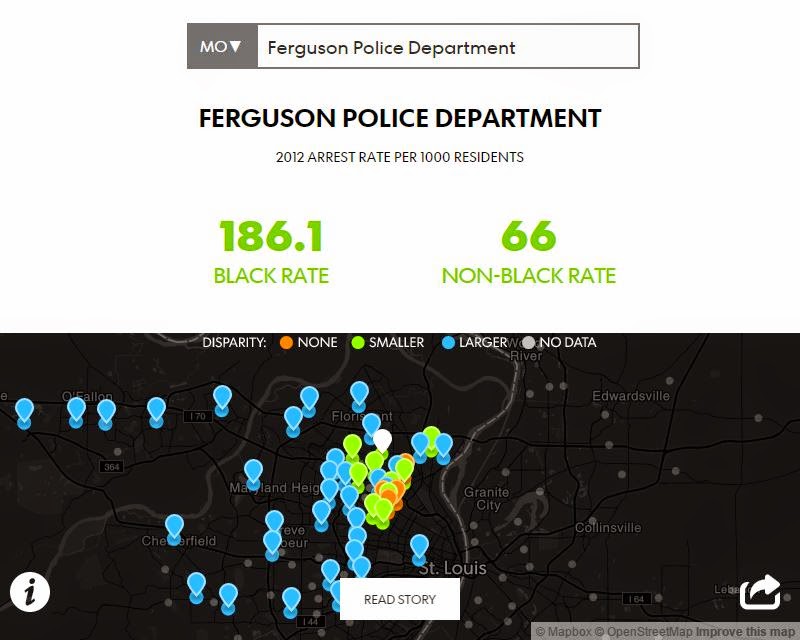
Here's Mesa, Arizona:

I was shocked when I saw these maps. I have spent my whole life thinking that my community was immune to racial profiling, but the opposite has proved to be true. It seems that the same concept applies to the rest of the country as well. My take on this is that in some cases a disparity makes sense. For example, if a city's population is predominately black, then of course the black arrest rate will be the highest. For a country where African Americans make up only 14% of the population, this map is overwhelmingly blue and green. As I watched the NBC Newsroom debate on violence in black communities, my thoughts went back to these pictures. Mr. Giuliani says that racial profiling isn't what's causing all of this turmoil, that rather the problem is isolated in black communities alone. But they numbers, they speak for themselves.
Mr. Giuliani's comments scare me because he is one voice that represents millions. There are people out there who see this map and will tell themselves that every single one of these arrests was sensible and justified, who will argue statistic after statistic on minority incarceration and recidivism before they consider that maybe the crimes weren't committed by the ones being arrested. I'd say that we all know at least five off the top of our heads. This mentality is toxic to our communities. Saying that the solution to black victimization is cracking down on interracial violence is like trying to get rid of a weed by pulling of a couple of its leaves. Sure, it's a part of the problem, but that weed is going to stay where it is and grow more and more until it is pulled out roots and all.
Mr. Giuliani's comment is a wake up call if anything. Yes, it is 2014 but people will still believe what they want to. The question is, what do we do about it? Do we try to convince them otherwise or do we just leave the bigots behind in the movement?
I believe that a bit of the problem lies in all of us, whether it's because of ignorance, or a lack of motivation to cure it. It's up to everyone to help be the change by finding the source of the problems and tackling it head on, even if putting the blame elsewhere is easier to do. The first step is accepting responsibility, then possibility and then moving forward from there.
Subscribe to:
Posts (Atom)